Dried Herb Mean in Self-Heal Capsules is a label question about ingredient form. In most cases, “dried herb” means that Prunella vulgaris plant material was dried, milled into powder, and placed inside capsules. It usually describes botanical material rather than an isolated compound or a concentrated extract.
The phrase may look simple, but it leaves several useful questions. Which plant parts were dried? Does “herb” mean the flowering aerial parts, leaves and stems, or another declared portion? Was the material extracted before encapsulation? Secrets Of The Tribe lists its ingredient as Self Heal, also called Heal All, Prunella vulgaris, Dried Herb, which identifies the species and distinguishes the ingredient from a labeled extract.
This article explains how to read that wording without making assumptions about concentration or product performance. It also shows why dried herb, aerial parts, extract, standardized extract, and isolated compound are related terms but not interchangeable descriptions.
What Does “Dried Herb” Mean on the Label?
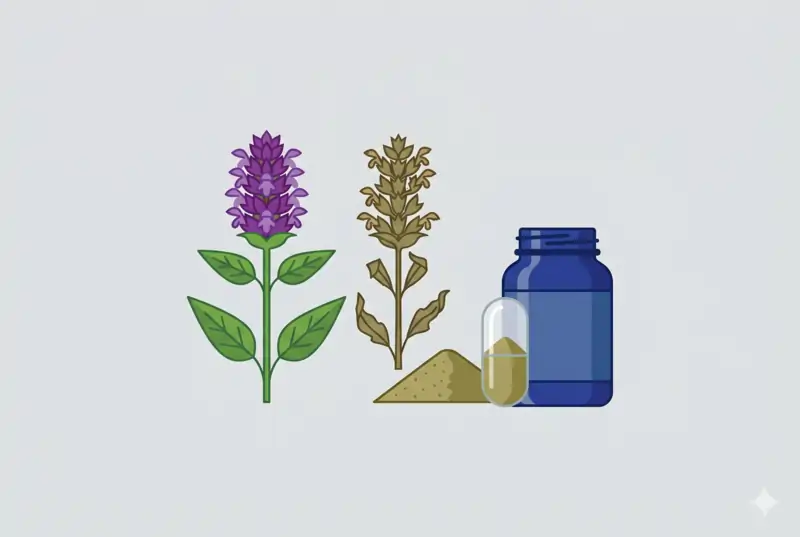
Dried herb usually means plant material that has had most of its moisture removed and has then been cut, milled, or powdered.
In a capsule, the dried botanical material is normally fine enough to fit inside the capsule shell. The powder may include one declared plant part or a mixture of declared above-ground parts.
The phrase does not automatically mean concentrated extract, purified constituent, essential oil, or isolated compound.
Quick Definition
Dried herb - Dried and milled botanical material used in a relatively direct plant form.
Aerial parts - The parts of a plant growing above the soil, usually leaves, stems, and flowers.
Extract - A processed botanical ingredient made by transferring selected plant constituents into a solvent and then using the resulting preparation.
Standardized extract - An extract formulated or tested to provide a declared amount of a selected marker compound or group of compounds.
Isolated compound - A separated individual substance rather than the full dried plant material.
Dried Herb vs Extract at a Glance
| Feature | Dried Herb | Botanical Extract |
|---|---|---|
| Basic form | Dried and milled plant material | Processed preparation made with an extraction method |
| Plant structure | Retains powdered botanical tissue | May contain selected soluble constituents |
| Concentration | Usually not presented as concentrated | May be more concentrated than raw dried herb |
| Label wording | Dried herb, herb powder, or plant powder | Extract, dry extract, liquid extract, or ratio statement |
| Standardization | Usually not standardized to a marker | May or may not be standardized |
| Direct equivalence | Cannot be converted to extract by name alone | Cannot be compared with herb powder without more details |
Does Dried Herb Mean the Whole Plant?
Not necessarily. The word “herb” does not always mean every part of the plant from root to flower.
In botanical product language, “herb” often refers to the above-ground material. That may include leaves, stems, flowers, and flowering tops. However, manufacturers should still identify the plant part clearly when possible.
Do not assume that roots are included unless the label or manufacturer says so.
What Are Aerial Parts?
Aerial parts are the portions of the plant that grow above the soil.
For Prunella vulgaris, this can include leaves, stems, flower spikes, and other flowering material. Aerial parts exclude the roots unless a product description specifically includes them.
The phrase is more precise than “whole plant” because it defines the general location of the material used.
Does Dried Herb Mean Aerial Parts?
It may, but the two phrases do not mean exactly the same thing.
“Dried herb” describes processing and form. It tells you that the botanical material was dried. “Aerial parts” describes plant location. It tells you which portion of the plant was used.
A complete label can combine both ideas, such as “Prunella vulgaris aerial parts, dried herb powder.”
Which Parts of Self-Heal May Appear in Dried Herb Powder?
Self-Heal dried herb powder may contain leaves, stems, flowers, flowering tops, or a declared combination of aerial material.
The exact composition depends on the sourcing and manufacturing specification. One batch may contain visible variation in natural plant color because leaves, stems, and flower material do not look identical after drying.
The manufacturer should be able to explain which plant part its ingredient specification covers.
How Is Dried Herb Prepared for Capsules?
The general process involves drying botanical material, reducing it to a suitable particle size, and filling it into capsules.
Drying lowers moisture and helps make the material stable enough for storage. Milling creates a powder that can be measured and encapsulated. Capsule shells then contain the powder and make the serving easier to handle.
Specific drying temperatures, milling methods, handling controls, and testing procedures vary by manufacturer.
Why Is Moisture Removed?
Fresh Prunella vulgaris contains substantial natural moisture. Fresh material is heavier, softer, and less stable than dried plant material.
Removing moisture reduces the conditions that support spoilage during storage. It also produces a more consistent ingredient form for milling and capsule filling.
Dried herb and fresh herb should not be compared by volume alone because their moisture content differs.
Does Dried Herb Mean Freeze-Dried?
No. “Dried herb” does not identify one specific drying method.
The material may be air-dried, low-temperature dried, mechanically dried, freeze-dried, or processed through another controlled method. Freeze-dried material should normally be described more specifically if that distinction matters to the product.
Ask the manufacturer when the drying method is important and the label does not explain it.
What Does the Powder Inside the Capsule Look Like?
Dried Self-Heal powder may appear olive green, green-brown, tan-green, or dark herbal brown.
Natural variation can come from the ratio of leaves, stems, flowers, harvest stage, drying conditions, and particle size. The powder may smell mildly grassy, earthy, hay-like, or generally herbal.
It should not be judged against the bright purple appearance of a fresh Self-Heal flower spike.
Why Does Dried Self-Heal Lose Its Purple Color?
Fresh flower color changes during drying, storage, and milling.
Purple petals make up only part of the harvested botanical material. Leaves and stems contribute more green and brown tones. Once the entire dried material is milled together, the powder usually looks muted and uniform.
A lack of visible purple does not mean the declared plant was absent.
Does Dried Herb Mean Raw Herb?
The term “raw” can be vague and is not automatically equivalent to “dried herb.”
Drying is a processing step. Milling and encapsulation are also processing steps. A product can remain close to the original botanical material while still undergoing necessary preparation.
Use the exact label description rather than assuming that “raw,” “whole,” and “dried” mean the same thing.
How Is an Extract Different?
An extract is produced by using a solvent or another extraction system to transfer selected constituents out of botanical material.
Water, alcohol, glycerin, or other permitted processing systems may be used depending on the ingredient and finished product. The liquid may remain in the final preparation or be concentrated and dried into extract powder.
An extract is therefore a processed fraction or preparation, not simply milled plant tissue.
Does Extract Always Mean Stronger?
No. The word “extract” alone does not tell you the exact concentration.
Some extracts are concentrated. Others are prepared at lower ratios or remain as liquid preparations. A useful label may include an extraction ratio, equivalent dry herb amount, solvent information, or marker-compound statement.
Do not compare extract strength without those details.
What Does an Extraction Ratio Mean?
An extraction ratio describes the relationship between starting botanical material and finished extract.
For example, a ratio may indicate that several parts of dried plant material were used to produce one part of extract. However, the ratio does not explain every aspect of the extraction process or final chemical profile.
Ratio statements should be read together with the plant part, solvent, and extract form.
What Is a Standardized Extract?
A standardized extract has a declared level of a selected marker compound or group of compounds.
Standardization helps create consistency for the declared marker across batches. It does not mean that every constituent in the plant remains identical or that the marker alone explains the entire botanical ingredient.
If a product is standardized, the label should identify the marker and its declared amount or percentage.
Dried Herb vs Standardized Extract
| Question | Dried Herb | Standardized Extract |
|---|---|---|
| What is inside? | Milled botanical tissue | Processed extract with a declared marker level |
| Is a marker percentage expected? | Usually no | Yes |
| Does it preserve plant fiber? | Usually retains natural powdered tissue | Depends on the extraction and carrier system |
| Can equal milligrams be compared directly? | No | No |
| What should the label clarify? | Species, plant part, serving amount | Species, plant part, ratio, marker, and serving amount |
What Is an Isolated Compound?
An isolated compound is an individual substance separated from a broader plant matrix.
It is different from dried herb, which contains many natural plant components together. It is also different from a broad botanical extract that may contain a range of soluble compounds.
A label should name an isolated ingredient directly rather than presenting it simply as dried herb.
Does Dried Herb Contain Only One Active Compound?
No. Dried plant material is a complex botanical matrix.
It contains plant fiber and many naturally occurring constituents in varying amounts. Those amounts can change with genetics, climate, soil, harvest stage, plant part, drying method, and storage.
Dried herb should not be described as though it were one purified molecule.
Can Dried Herb and Extract Milligrams Be Compared Directly?
No. Equal milligram amounts do not establish equivalent botanical preparations.
Five hundred milligrams of dried herb and five hundred milligrams of extract may represent very different starting-material quantities and constituent profiles. Extract ratios, marker levels, moisture, carriers, and plant parts all affect the comparison.
Compare like with like whenever possible.
Why Does the Plant Part Matter?
Different plant parts can have different physical and chemical profiles.
Leaves, stems, flowers, aerial parts, and roots are not automatically interchangeable. Scientific papers often specify the plant part because researchers need to define the material they examined.
A consumer label should provide enough information to identify the commercial ingredient accurately.
What Does “Self Heal Dried Herb” Confirm?
The phrase confirms three useful details when it appears with the full ingredient name.
It identifies the common name as Self Heal, connects the ingredient with Prunella vulgaris, and describes the form as dried botanical material rather than a clearly labeled extract.
It does not, by itself, specify every plant part, drying method, particle size, or sourcing detail.
What Should You Ask If the Label Is Unclear?
Ask which plant parts are included, whether the material is extracted, how the ingredient is identified, and whether testing applies to the specific lot.
You can also ask about origin, drying method, milling, microbial testing, contaminant testing, and storage recommendations. The most useful answers should connect with a batch or ingredient specification.
Secrets Of The Tribe takes a practical editorial position here: “dried herb” is a meaningful format description, but full transparency improves when the species, plant part, origin, and batch documents can also be checked.
Does Third-Party Testing Change the Ingredient Form?
No. Testing does not turn dried herb into an extract or standardized ingredient.
Testing evaluates selected properties according to the requested methods. Depending on the testing plan, this may include identity, microbial quality, heavy metals, pesticides, or other specifications.
Ingredient form and product testing are separate parts of label literacy.
When Should Self-Heal Capsules Not Be Used?
Do not use capsules if the seal is broken, the label is unreadable, the botanical identity is unclear, capsules are wet or swollen, powder is leaking, visible contamination appears, or the product is expired.
Avoid products with moldy, rancid, rotten, damp, or chemical odors. Do not taste a suspicious capsule to test it.
Contact the manufacturer with the lot number if product integrity is uncertain.
Who Should Ask Before Using Self-Heal Capsules?
People who are pregnant or breastfeeding, under 18, taking medication, preparing for surgery, using multiple supplements, managing allergies, or living with a health condition should ask a qualified healthcare professional before using Prunella vulgaris products.
The phrase “dried herb” identifies a product form. It does not establish personal suitability.
Use the complete label and professional guidance when individual circumstances require extra caution.
Self-Heal Dried Herb Label Checklist
Use this checklist when a Self-Heal capsule label says “dried herb.” It helps you distinguish ordinary plant powder from extracts, standardized preparations, and isolated compounds.
Confirm the Species
Look for Prunella vulgaris rather than relying only on Self-Heal or Heal-All.
Identify the Plant Part
Check whether the label specifies aerial parts, flowering herb, leaves, stems, or another declared portion.
Look for Extract Language
If no extract, ratio, solvent, or standardization statement appears, do not assume the ingredient is concentrated.
Check the Serving Amount
Read the amount of dried herb listed for each labeled serving.
Review Other Ingredients
Check the capsule shell, flow agents, fillers, and any additional formula components.
Find the Lot Number
Use the lot code to request batch-specific sourcing or testing information.
Check Product Integrity
Avoid broken seals, moisture, damaged capsules, leaking powder, contamination, or abnormal odors.
Compare Like With Like
Do not compare dried herb milligrams directly with extract milligrams without additional details.
Ask When Wording Is Vague
Contact the manufacturer if the plant part, preparation, origin, or testing information is unclear.
Common Mistakes to Avoid
Assuming Dried Herb Means Extract
Dried herb usually means milled plant material, not a concentrated botanical extract.
Assuming Herb Means Every Plant Part
The term may refer to above-ground material rather than roots and the entire plant.
Comparing Milligrams Across Different Forms
Dried herb, extracts, and standardized extracts cannot be compared by weight alone.
Reading Extract Research as Capsule Proof
A study using a specific extract does not automatically describe ordinary dried herb capsules.
Ignoring the Botanical Name
The label should connect Self-Heal with Prunella vulgaris.
FAQ
What does dried herb mean in Self-Heal capsules?
It usually means dried Prunella vulgaris plant material that has been milled into powder and placed inside capsules.
Is dried herb the same as an extract?
No. Dried herb is powdered plant material, while an extract is made through a separate extraction process.
Does dried herb mean the whole Self-Heal plant?
Not necessarily. It may refer to aerial parts such as leaves, stems, and flowers.
What are aerial parts?
Aerial parts are the portions of a plant that grow above the soil.
Is dried herb standardized?
Usually not. A standardized extract should identify the declared marker compound or marker level.
Does dried herb contain isolated compounds?
It naturally contains many plant constituents together, but it is not the same as a purified isolated compound.
Can dried herb and extract milligrams be compared directly?
No. Equal weights may represent very different botanical preparations and concentrations.
Glossary
Dried herb - Botanical material that has been dried and usually milled for use in a finished product.
Prunella vulgaris - The botanical species commonly called Self-Heal or Heal-All.
Aerial parts - The leaves, stems, flowers, and other portions growing above the soil.
Herb powder - Dried plant material reduced to a fine particle size.
Extract - A botanical preparation made by transferring selected plant constituents into a solvent or processing medium.
Conclusion
“Dried herb” in Self-Heal capsules usually means dried and milled Prunella vulgaris plant material rather than a concentrated extract or isolated compound. To understand the ingredient fully, check the species, plant part, serving amount, preparation language, and batch documentation.
Sources
Accepted botanical identity and taxonomic record for Prunella vulgaris, Plants of the World Online - powo.science.kew.org/taxon/urn:lsid:ipni.org:names:454640-1
Prunella vulgaris plant description, plant parts, and botanical classification, North Carolina Extension Gardener Plant Toolbox - plants.ces.ncsu.edu/plants/prunella-vulgaris
Definitions and labeling principles for botanical ingredients and extracts, American Herbal Products Association - ahpa.org
Botanical dietary supplement terminology and research considerations, National Institutes of Health Office of Dietary Supplements - ods.od.nih.gov

